Hand-crafted ragtime, jazz & swing — sophisticated music that celebrates love — lost, found, discarded or denied. Concerts filled with amusing anecdotes, memorable melodies, clever lyrics and vintage American acoustic guitars.
Ken Lelen
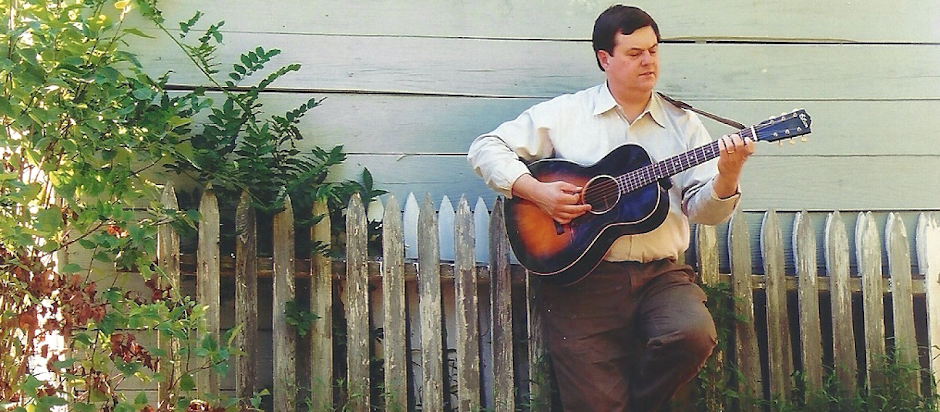
Ken Lelen sings great American ragtime, jazz & swing and plays vintage acoustic guitars for an authentic, back-in-the day sounds. Photo by Mike Nixon - Aug 2002.
Thursday, August 2, 2018
Regal "Custom-Built" Guitars
Collector's Guide To Identification — Part 1
Lack of production, shipment, jobber and sales data thwarts accurate dating of Regal Custom-Built guitars made from 1928 to 1936. So we've compiled info from recent dealer listings, repair records, auctions, sales and other sources sowe can begin to correlate this data for vintage guitar owners.
Almost every time someone buys a
vintage Regal guitar, I get an email asking me what year their
guitar was made. As I’ve told people for years, “Can’t give you a date. No one knows — yet." From 1928 to 1936 Regal Musical Instrument Co. of Chicago produced
a large quantity but unknown number of "Custom-Built" acoustic guitars. It may have recorded manufacturing, distribution and sales data, but no such data has arisen, so guitar
owners can't verify a date for their vintage Regals.
Some surviving Regals guitars have headplate logos. Some have no headplate logo. Some have a serial number on the neck block and some have it on an interior label branded "Regal," "Custom-Built" or the name of a jobber (B & J, S.S. Stewart, etc.). Some have a serial number on the neck block and label, while some have no serial number at all. And then, just to stymie today’s collectors, some vintage
Regals lack any identification at all.
Not like dating a Martin Vintage Gibson and Martin collectors rely on serial numbers, factory
order numbers, repro and original catalogs, shipping info, even retail and jobber sales materials to date a guitar. We owe
our gratitude to George Gruhn, Joe Spann, Mike Longworth and other researchers for compiling such vintage records. Unfortunately, no such data on
Regal guitars seems to exist. Lack of factory records, jobber contracts, sales
receipts, etc. stymie correlation of a known serial number on a guitar to a specific date. Incomplete, unreliable and sloppy listings by guitar dealers and online sellers exacerbates the problem. Without correlation, establishing provenance
is difficult. Presence of an original owner’s receipt, period
photo, heir's letter, etc. may help the dating of a vintage Regal. But 90 years later, we have no means to date an individual guitar's initial sale date, production or shipment. Regal’s Custom-Built
guitars Regal’s line ofCustom-Built
guitars were well-made and sold across the country between 1928 and 1936.
Made in five styles with slotted headstocks, each had mahogany necks, ebony
fingerboards, ebony bridges, X-braced white or eastern spruce tops, mahogany or
rosewood bodies, and quality tuners.
Some styles carried no Regal or Custom-Built brand, while others had a label on the back brace. Some had a Regal logo within a black or green circle. Others had an oval metal badge nailed to the rear of the headstock. Finally, some Regal guitars had an ink-stamped serial number on the neck block. In some, it's located on an interior paper label. Some had it in both locations. And some had none at all. Some of Regal's Custom-Built guitars were sold to Montgomery Ward, a catalog firm that sold guitars in retail outlets. Some were also shipped to such wholesale firms as Tonk Brothers of Chicago and B & J of New York. These firms sold the Custom-Built line across North America with various house brands to a discrete mix of retailers.
1928 catalog page from Grossman Music Co., a Cleveland jobber, showing the five styles of Regal "Custom-Built" guitars.
Three Custom-Builtstyles were concert-sized, with a lower bout width of 13¼ in. Two styles were grand concert-sized, with a lower bout width of 14½ in. Prices were set at $20 and $25 for the concert-sized mahogany units, $28 on the grand concert-sized mahogany model, and $45 and $50, respectively, for concert-sized rosewood unit and grand concert-sized rosewood unit.
Regal's Custom-Built guitars competed in style,
tone and cost with guitars made by the C.F. Martin Co. of Nazareth PA. Although produced in similar sizes, finishes, materials and appointments, prices on Regal's Custom-Built guitars were 20 to 30 percent less than Martin guitars. Regal guitars from the 1930s-era are widely available in today's vintage guitar markets. Yet, some vintage dealers arrogantly sniff if asked to compare values on vintage Martins and vintage Regals. In my opinion, vintage Regals compare well in design, construction, materials, tone and playability. They fail, however, to meet the flatulent reputations and exaggerated values claimed by vintage Martin dealers and online sellers.
For example, Martin’s mahogany 00-18 cost $45, while a similar Custom-Built Style No. 3 cost $28. Martin’s rosewood 0-21 cost $55, while the Custom-Built Style No. 4 cost $45. And Martin’s rosewood 00-21 cost $60, while the Custom-Built Style No. 5 cost $50. Regals’ MarvelTone guitars Finally,
an unknown number of Regal-made guitars with grand-concert (14½ in. wide) mahogany and rosewood bodies display a MarvelTone headplate inlay and snazzy fingerboard inlays. It is believed these instruments were shipped
during the 1930s by Targ and Dinner Music Co., a Chicago jobber.
L. to R., three MarvelTone guitar variations: only headplate logo; only fingerboard inlays; and both a headplate logo and fingerboard inlays. Like everything else in the Regal universe, MarvelTone guitars appear in several
configurations. Some have fingerboard
inlays, but no headplate logo. Some have a headplate logo, but no fingerboard
inlays. Some
have Custom-Built paper labels. Some have
Regal metal badges. Some have a
serial number. Some do not. Only two MarvelTones
— a Style No. 3 and a Style No. 5 — have been found with the MarvelTone
headstock logo, pearl fingerboard inlays and serial #. The Style 3 has a serial # on the neck block, while the Style 5 has a serial # on a Custom-Built paper label. See http://kenlelen.blogspot.com/search?q=Marvelousfor info on this pair of Style No. 3 and Style No. 5 MarvelTones. Documenting what's known about vintage Regal
guitars We have info on the design, construction and appointments
of vintage Regals. But we can't verify dates on production,
distribution and sales of an instrument. Vintage
Music Concerts recently compiled data from dealer
listings, luthier repair jobs, sales, and other info on Regal, Custom-Built and MarvelTone guitars made from 1928 to 1936. Called Vintage Regal "Custom-Built" Guitars — Part 2, it was posted on thiswebsite on Thursday, August 2, 2018 so owners, buyers, sellers and researchers can learn and
share info on vintageRegal instruments. As you scan the charts, we hope you'll supplement the data and
correct gaps. You can also contribute info on newly listed, repaired and sold vintage Regals. Ultimately, we can establish an
edifice of verified documents, data and dates about some really nice vintage
guitars.
Great American ragtime, jazz and swing for music clubs, senior villages & public libraries _____________________________________________________________
Several
years ago I spied an auditorium-sized Maurer model guitar built by Carl and August Larson on the website of
Schoenberg Guitars, a Tiburon, CA vintage instrument dealer. Presented as a finely
made, mid-1920s instrument with a unique, non-Martin sound, it was a less
costly alternative to a comparable 12-fret 000-18 Martin from the same era.
c. 1926 Maurer Style 493 by Larson Brothers
To my delight the guitar has exceeded my
expectations. Whether played fingerstyle or flatpicked, it is a joyous
musical treat with a bright, warm midrange that sounds like no other six-string
acoustic guitar. Indeed, it is especially good for the ragtime and early jazz
tunes of the 1920s and 1930s that I perform at my concerts across the East
Coast. A Maurer Style 493 (no serial number), it has a fine-grain ribbon mahogany back
and sides and X-braced white spruce top with non-laminated bracing. The instrument has
an ebony fingerboard and flattened-pyramid ebony bridge. It has a
V-shaped mahogany neck with 12 frets to the body and 1-7/8-inch nut width. It
also has a 15-inch lower-bout width, 3-5/8-inch body depth and 25-1/2-inch
scale length. Now 90+ years old, it was restored
in 2007 by luthier Chris Berkov of Novato CA. Today it has a perfect action as well as
a smooth and balanced tone thanks to the integrity of its original design
and Berkov's work. This guitar also has a surprise inside on its back rib: period brands in wood, one for Maurer and one for S. Ernest Philpitt. They offer a hint of its special design and early history. They also open a window on this guitar's journey from a two-man guitar shop in Chicago to a jazz-era music retailer in Florida who first sold it and, ultimately, into the hands of today's vintage guitar dealers, restorers, collectors and players.
Maurer (maker's brand) on left and S. Ernest Philpitt (retailer's brand) on right
Maurer Style 493 was hand-built by the Larson Brothers A steel-stringed beauty, the guitar was
built circa 1926 by Carl and August Larson, who emigrated from Sweden to
Chicago in the mid-1880s. By one estimate the pair built 2,500 guitars,
mandolins and harp-guitars between 1900 and 1940 under various trademarks,
including Maurer, Dyer, Stetson, Stahl, Prairie State and Euphonon. Half of
these were guitars; sadly, a small number, perhaps a couple hundred, of these instruments are
known to exist today. Larson guitars were popular
with singing cowboys, country music stars and other entertainers during
the 1920s, 1930s and 1940s. Famous Larson owners included Gene Autry ("Public Cowboy No. 1"), Patsy
Montana ("Cowboy's Sweetheart"), Ester Martin and Kay Reinberg (the "Prairie Sweethearts"), Luther
Ossenbrink ("Arkie the Woodchopper") and Lloyd Perryman (one of the "Sons of the Pioneers).
Back in the day many of these musicians performed on National Barn Dance, a Saturday
night program airing on WLS-AM radio in Chicago.
In addition to a Maurer
trademark on its back rib, this guitar has a wood stamp that says it was
"Manufactured Expressly for S. Ernest Philpitt." With stores in
Washington, DC and six Florida cities, Philpitt (1874 - 1945) sold sheet music, pianos, records, recording players and guitars by Vega, Maurer, Gibson, Ditson and
Martin.
S. Ernest Philpitt Men of the South - 1922 Published by Southern Biographical Assn., New Orleans, LA
"Anything in the musical line ... from
jew's harp to a grand piano" can be purchased in his stores, Philpitt boasted in a June 29, 1918 profile published in Music Trade Review, an industry journal. Philpitt was a fascinating character. He began
his musical career at age 11 by selling sheet music, talking machines
and band instruments for retailers in Washington, Philadelphia and
Baltimore. By 1910, at age 36, he was general manager of American Music
Stores in N.Y. City, which operated 28 stores in 23 U.S. cities. Six years later he
launched his own venture by acquiring a sheet music shop in Washington, DC and
opening a retail store in Jacksonville. In less than a decade he expanded
his enterprise with additional stores in Miami (1916), Tampa (1917), St.
Petersburg (1922), West Palm Beach and Orlando (1923). The Florida firm's retail premises and musical merchandise sustained periodic
damage from hurricanes, yet Philpitt continued to expand his chain of
stores. In May 1925, when opening a Miami Beach unit, he told Music
Trade Review annual sales for Philpitt & Son had reached
three-quarters of a million dollars. Philpitt attributed his success to a knack at placing Victrolas and musical
instruments in local schools, bands, orchestras and churches and to making it
easy for his customers to hear and buy records. When he expanded his Orlando
store in January, 1925, he told Presto-Times he “offered music
loving persons six record demonstration booths furnished as de luxe living rooms."
But it was the South’s fervor for
"syncopating, fascinating jazz" that gave the firm its biggest
boost, Philpitt claimed in an April, 1919 article in Music
Trades. “There’s a pressing
demand for jazz instruments such as the saxophone, clarinet, trombone, cymbals,
ukulele-banjos,” especially in Miami, Jacksonville and Tampa, he said.
Early on Philpitt offered
Sunday afternoon classical music soirées at his Miami store. In the late 1920s
the impresario introduced such classical musical artists to Lower Florida as: operatic tenor Paul Althouse (1889 – 1954); basso Edward Lankow (1883
– 1940); violinist Mischa Elman (1891 – 1967); and pianist Arthur Rubenstein
(1887 – 1982).
Beginning in 1930 Philpitt’s music recitals
received radio airplay across the Sunshine State, though often at his own
expense. But by then he'd solidified his reputation in the music industry as
president of the Sheet Music Dealers Assn. and secretary of the National Music
Merchant Assn. (now called NAMM).
S. Ernest Philpitt & Son saw
three generations of family management between 1916 and 1982. The founder
brought his son, Marshall Swisher Philpitt (1902 – 1967), into the
business in 1925 when it incorporated. Marshall managed the Philpitt
business from the 1930s until 1945, when his son, Marshall
Swisher Philpitt Jr. (1922 - 2011), took over. Junior ran the stores
until 1980, after which the family formally dissolved the firm.
Pre-restoration photographs found
The more I learned
about the man who sold my guitar in Florida in the late 1920s or early
1930s, the more I knew Philpitt's trademark was as valuable as the Maurer
label. This insight blossomed when I found photographs of my guitar among
several Larson guitar photos on a website managed by Dan Alexander, a Berkeley,
CA dealer.
In Alexander’s gallery my guitar was displayed in lacklustre condition with a
rosewood bridge and fingerboard markers (pearl dots) on the 3rd, 5th,
10th and 12th frets. The photos also showed wood
grain lines in the mahogany back and headstock as well as surface dents, case
bites and finish blemishes to the top in the identical locations
as my guitar.
Alexander's soundhole photo revealed identical wood trademarks for Maurer
and Philpitt. In effect, his photos show this guitar before its restoration — a
key resource for any vintage guitar owner.
Sadly, he could not say who owned the Maurer 493 on his site or offer any provenance. "I'm
afraid I have no specific memory of your guitar," he told me.
When Schoenberg acquired the guitar, the top and back finish was badly worn and the original tuning machines had
failed. What's more, it needed a neck reset, proper bridge, bridge-plate
patch and other set-up work.
Maurer Style 493 repairs and updates
According to Schoenberg, Berkov's
repairs included: refinishing the top, sides and back with French polish; shaving,
but not refinishing, a sharp V in the mahogany neck; installing an ebony bridge with flattened wings and pearl inlays in a
stylized cloverleaf; replacing the faulty original tuning machines with new engraved Waverly
slot-head tuners; and replacing the original Argentan or German silver frets (an alloy of
nickel, copper and zinc) with modern frets.
The instrument originally had fingerboard
markers (1/4-inch diameter pearl dots) at the 5th, 7th, 10th and 12th frets.
For some reason - perhaps to appeal to modern players - Berkov moved the 10th
fret marker to the 9th fret. Alas, when I called Berkov in June 2009 to discuss
the work he'd done on this guitar, he said he could not remember the instrument
or the restoration work. Nevertheless, today the woody tone of this
Maurer Style 493 is powerful, with a big bottom end, full projection,
individual note clarity, head room to spare, and huge, shimmering sustain. "It has the preciseness we've come to
expect from Larsons," Schoenberg said. "A beguiling vintage guitar,
with charm, class, and unique, non-Martin sound."
Acquiring this Maurer 493 in a trade
I acquired
this Maurer Style 493 in early 2009. At the time I was considering the sale of
a 1937 Martin 00-18H, one of 255 made between 1935 and 1941 and priced for $55.
It is a fine grand concert guitar (SN 65183), called the Lorizio after its
original owner, JeanetteLorizio, nee
Porcello, who was born January 2, 1913 and deceased December 30, 2000 in
Norton, MA near Boston. Long-ago converted from its original
Hawaiian set-up, I acquired it in decrepit condition for $5,500 in June 2007 at the
height of the vintage guitar market from vintage dealer Fred Oster in
Philadelphia, PA. By year's end I paid luthiers Greg Hanson and David Crawford
of Raleigh, NC another $1,650 to restore it. Hanson and Crawford's work included: neck reset; fingerboard planing to achieve proper radius and removal of a hump
at the 12th fret; refretting with modern T frets; installing a forgery-grade ebony bridge and intonated bone saddle; gluing a small piece of maple rescued from a 100-year-old piano onto the
original bridge plate to eliminate string-ball damage; repairing two small irregular holes in the upper treble rib; and set-up work to accommodate my flatpicking playing style. Though the quality of Hanson & Crawford's work was beyond reproach, Oster sniffed dismissively when he
examined the fully restored guitar in January 2009. He called the work
"passable, not great." Whether accurate or not, Oster's negative
opinion of a perfectly fine guitar spelled trouble. It could spoil my chance to
ever sell the guitar through his shop or elsewhere in the vintage guitar market. So I looked for a way to trade it away.
When the Larson appeared for $6,675 at Schoenberg's website, I jumped to trade
the Lorizio 00-18H for the Maurer 493, netting $1,000 from Schoenberg in the
process. The Lorizio is a great guitar and I enjoyed
playing the restored instrument for a year. Still, I don't miss it. On the
other hand, the Maurer 493 is an outstanding instrument that offers sublime
pleasures to its player. Indeed, it's hard to put down even after playing it an
hour or more. Listen to this c. 1926 Maurer Style 493
For years I've played vintage guitars and sung vintage songs, pairing each song with a guitar made in the same period. For this performance of "Nobody Knows You When You're Down and Out," composed by Jimmie Cox in 1923, I'm playing my 1926 Maurer Style 493. My accompanist is Matt Koch on bass.
The song was a hit in the 1920s and 1930s for Bessie Smith and other female blues singers who bemoaned the vicissitudes of fortune and the fickleness of friends amidst hard times. More recently, the song was popularized by Eric Clapton at his so-called Unplugged Concert of August, 1992.
This video was made in July, 2009 at Minstrel Coffeehouse in Morristown, NJ when we opened for jazz guitarist Bucky Pizzarelli. Unlike that Clapton feller's guitar, you'll notice there are no pick-ups, no wires and no electronic gimmicks attached to this vintage guitar.